

PBAT pneumatic conveying solution for pellets
During the conveying of PBAT (polyadiic acid/butylene terephthalate) pellets, manufacturers often face issues such as poor material flowability, pipeline blockages, dust escaping, and high energy consumption. Head Powder addresses these pain points by offering customized PBAT pneumatic conveying solutions, systematically designed to achieve stable, clean, and efficient material transfer.
Customer pain points
PBAT pellets have strong hygroscopicity, high surface adhesion, and uneven particle size. In traditional mechanical conveying, bridging, caking, and pipeline accumulation often occur, leading to frequent shutdowns for cleaning. At the same time, dust pollution from open conveying not only affects the workshop environment but also increases material loss and equipment maintenance costs. If the current pneumatic system is poorly designed, it can cause large fluctuations in conveying pressure, high energy consumption, noise, and other issues, making it difficult to meet the stable demands of continuous production.
Material characteristics
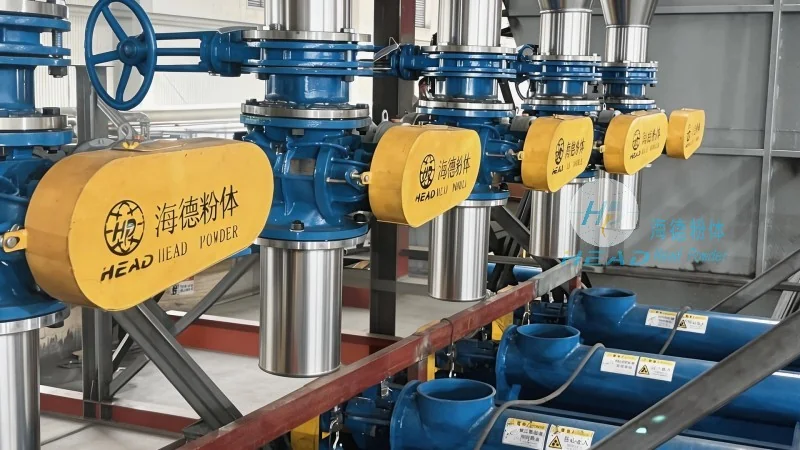
PBAT particles are thermoplastic degradable materials with a density of about 0.6~1.0 g/cm³, a large repose angle (>45°), and poor flowability. The surface of the particles easily absorbs moisture, and during conveying, frictional heat may cause adhesion. Additionally, the material is sensitive to shear, so high-speed airflow must avoid particle fragmentation or temperature rise. These characteristics place high demands on the pipeline material, air velocity control, elbow structure, and dust removal device of the pneumatic conveying system.
Product Introduction
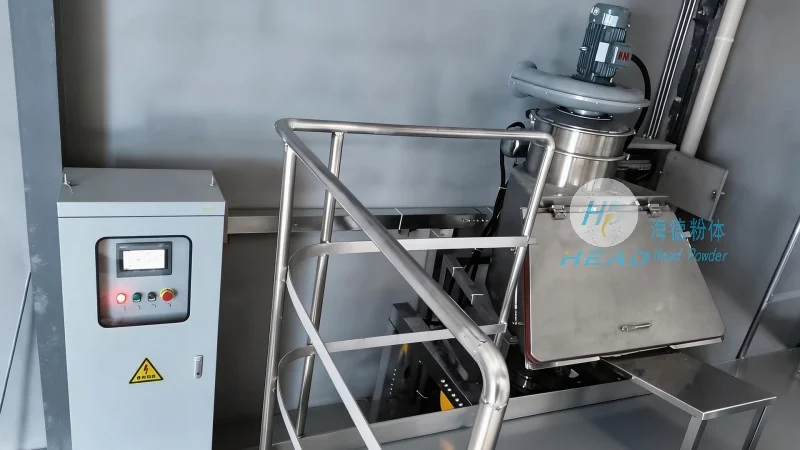
The Head Powder PBAT particle pneumatic conveying system adopts positive pressure dense phase or dilute phase conveying modes, customized according to the customer's on-site working conditions. The system consists of a feeding device, conveying pipelines, air source equipment, separation and dust removal unit, and an automated control system. To address PBAT viscosity, the feed port is equipped with an anti-bridge arch breaking mechanism, the inner wall of the pipeline is polished with mirror polishing or an inner wear-resistant coating, and the elbow curvature radius is optimized to reduce material retention at the curve. The air source selects Roots fans or compressed air systems according to pressure requirements, paired with pulse back-blow baghouse dust collectors or cyclone separators, which help meet exhaust emission standards and achieve high material recovery rates. The entire system achieves fully automatic control through PLC+HMI, allowing real-time monitoring of conveying pressure, material level, flow rate, and other parameters.
Product advantages
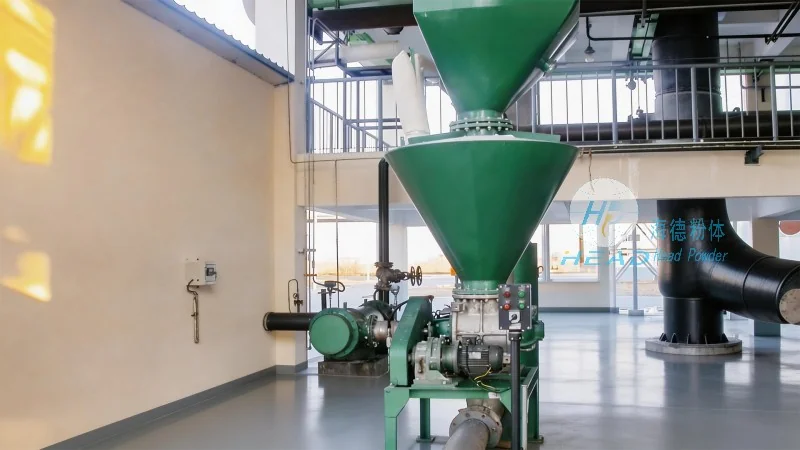
Solutions for customer pain points:
- Anti-blocking design: Uses arch-breaking feeding and low-speed dense phase conveying to reduce friction between material and pipe wall, preventing sticking and blockage.
- Fully sealed and environmentally friendly: Sealed negative pressure or positive pressure conveying throughout the entire process from feeding to unloading, preventing dust leakage and improving workshop air quality.
- Energy-saving and low consumption: By optimizing the air-solid ratio and calculating pipeline resistance, it matches high-efficiency fans to reduce energy consumption by 15%~30% compared to traditional mechanical conveying.
- Low wear and long service life: Uses wear-resistant materials and replaceable elbows to extend equipment service life and reduce maintenance frequency.
- Intelligent control: Automatically adjusts conveying speed and pressure based on level feedback, reducing manual intervention and adapting to interlock requirements for different processes.