

Pneumatic conveying solution for masterbatches
During the production and processing of masterbatches, traditional manual feeding or mechanical conveying methods often face issues such as low efficiency, dust accumulation, and severe material loss. At the same time, masterbatches are small and prone to static electricity, leading to blockages in conveying pipelines and accelerated equipment wear, which not only affects production continuity but also increases maintenance costs. In addition, the conveying requirements for different formulas and batches of materials vary greatly, lacking flexible adaptation solutions, making it difficult to meet the demands for cleanliness, efficiency, and accuracy in chemical production.
Material characteristics
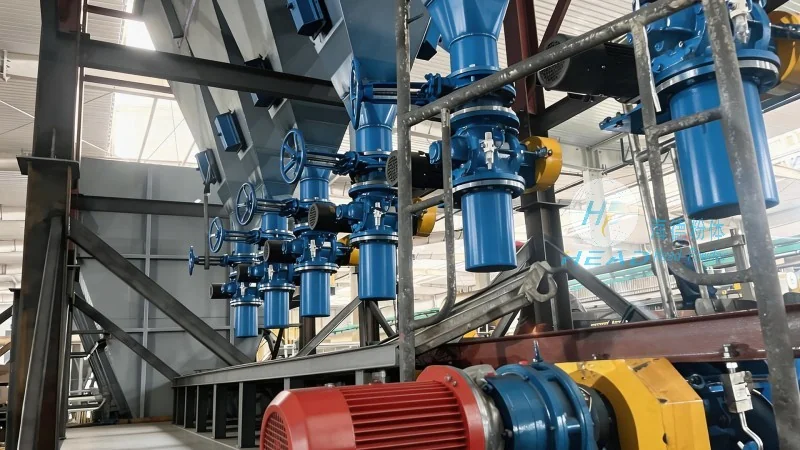
Masterbatch particles are usually cylindrical or spherical, with particle sizes between 1-5mm. After surface treatment, they exhibit typical lubricity, but particles tend to agglomerate due to electrostatic adsorption. It has good flowability but is prone to breakage or wear in high-speed airflow. At the same time, masterbatch is sensitive to temperature, and prolonged high temperatures may affect the dispersibility of the pigment. Therefore, the conveying system needs to have low speed, enclosed environments, anti-static, and gentle conveying capabilities to maintain material quality.
Product Introduction
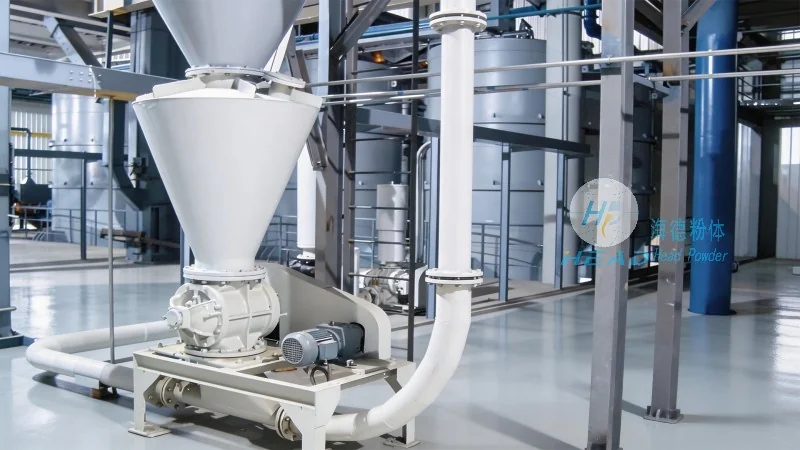
Head Powder's masterbatch pneumatic conveying solution uses sealed pipeline systems under positive or negative pressure, achieving fully automated conveying from the raw material silo to the processing equipment. The system can be customized according to customers' production capacity, workshop layout, and material characteristics, covering feeding stations, rotary feeders, Roots blowers, cyclone separators, pulse dust collectors, and intelligent control units. Through modular combinations, it meets the conveying needs of different specifications of masterbatches, while also supporting collaboration with equipment such as extruders and injection molding machines, reducing manual intervention and improving overall efficiency.
Product advantages
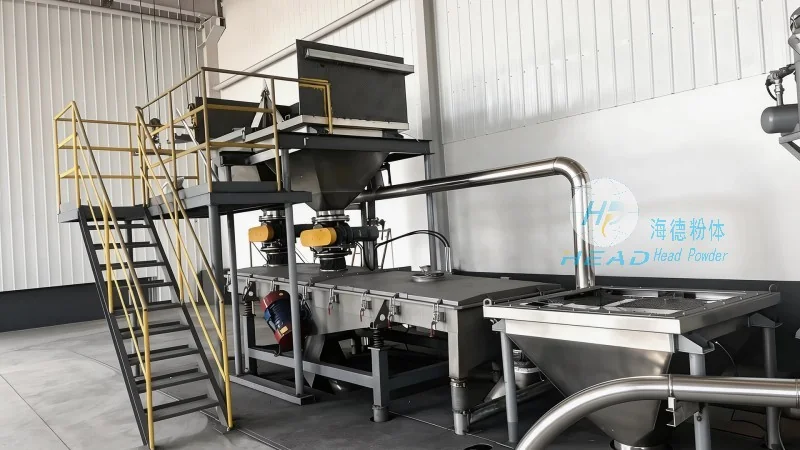
To address the customer's challenges in dust pollution and unstable conveyance, this solution adopts a fully enclosed pipeline structure to effectively prevent dust leakage and improve the workshop environment. Built-in anti-static design and airflow speed control module to prevent material blockage and particle damage. Accurate feeding is achieved through variable frequency speed regulation and load cells, reducing material loss. The system supports customized expansion, allowing parameters to be flexibly adjusted according to subsequent process changes, reducing repeated investments for customers. Overall energy consumption has been optimized, reducing energy consumption by about 15%-25% compared to traditional mechanical conveying, while extending equipment maintenance intervals.